The Bridge:
Why Communication Matters More Than Most Feng Shui Consultants Realize
June, 15 2026 by Juergen Mueller
DiSC® is referenced in this article as a general communication framework and not as a certified assessment tool.
A Feng Shui audit is often seen as a technical exercise.
The consultant visits a property, takes measurements, analyses the environment, evaluates the internal layout, studies the occupants, and finally provides recommendations.
At first glance, success appears to depend on one thing: knowledge.

A successful Feng Shui audit depends on three factors:
- The consultant’s knowledge and experience
- The consultant’s professional presence (You might also want to read this article)
- The communication between consultant and client
Most Feng Shui practitioners spend years developing the first factor. Some work on the second. Very few give enough attention to the third.
And yet communication is often the difference between recommendations that are implemented and recommendations that end up forgotten in a drawer.
The Real Purpose of a Feng Shui Audit
A Feng Shui audit is not simply an analysis.
It is a transfer of knowledge.
The consultant brings years of study, practical experience, observations, case histories, and technical understanding. The client usually does not.
The client does not need to become a Feng Shui expert.
The client only needs to understand the recommendations clearly enough to apply them successfully.
That sounds simple.
In practice, it is often the most difficult part of the entire process.
Why Good Recommendations Sometimes Fail
Imagine a consultant explains:
“According to the Flying Star chart and the environmental influences, it would be advantageous to relocate your home office to the northwest sector.”
Technically correct.
But what happens next?
Some clients immediately ask:
“Excellent. When should I move it?”
Others ask:
“Why exactly?”
Others ask:
“Will this affect my family?”
And some are still wondering what a Flying Star chart actually is.
The problem is not Feng Shui.
The problem is communication.
The same recommendation often requires completely different explanations depending on the listener.
This is where DiSC® becomes useful.
Building the Bridge
Do not use DiSC® as a psychological diagnosis.
Use it as a communication framework.
DiSC® helps us understand how people prefer to receive and process information.
Once we understand this, we can explain Feng Shui recommendations in a way that makes sense to the client.
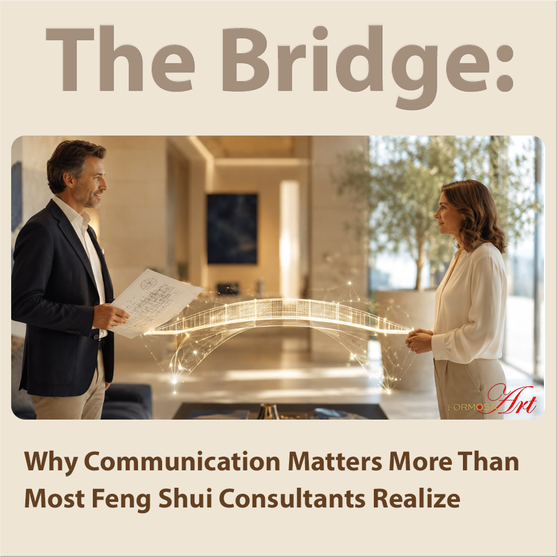
Think of DiSC® as a bridge.
The consultant stands on one side with expertise.
The client stands on the other side with questions, expectations, and concerns.
Communication builds the bridge between the two.

The Four Communication Styles
D – Dominance
People with a strong D style tend to be direct, decisive, and results-oriented. They usually want conclusions before explanations.
Typical questions:
• What should I do?
• How long will it take?
• What result can I expect?
Instead of:
“Let me explain the theory first.”
Try:
“This change is likely to improve your working environment and productivity. Let me show you how.”
The D style values efficiency.
Give them the destination first.
I – Influence
People with a strong I style are often enthusiastic, expressive, and relationship-oriented. They respond well to stories, examples, and possibilities.
Typical questions:
• How will this feel?
• What experiences have others had?
• What opportunities does this create?
Instead of:
“The annual stars indicate a favourable influence.”
Try:
“Many clients describe this type of adjustment as creating a more uplifting and inspiring atmosphere.”
The I style connects through experience and emotion.
S – Steadiness
People with a strong S style value harmony, stability, and predictability. They often need reassurance before making changes.
Typical questions:
• Is this really necessary?
• Will it disrupt my routine?
• What happens next?
Instead of:
“You should change this immediately.”
Try:
“We can implement this gradually. There is no need to rush.”
The S style prefers stability and a sense of safety.
C – Conscientiousness
People with a strong C style are analytical, precise, and detail-oriented. They want evidence, logic, and clear reasoning.
Typical questions:
• How did you arrive at that conclusion?
• What data supports this?
• Can you explain the methodology?
Instead of:
“Trust me.”
Try:
“Let me walk you through the analysis step by step.”
The C style values understanding before action.
The Most Important Person to Understand Is Yourself
Before identifying the client’s style, the consultant should understand their own.
Most communication problems occur because we naturally explain things in the way we prefer to receive information.
A highly analytical consultant may overwhelm a D client with detail.
A highly enthusiastic consultant may frustrate a C client with insufficient structure.
A very direct consultant may unintentionally intimidate an S client.
Awareness of your own communication style is the first step.

Discovering the Client’s Style
Formal assessments are not necessary during an audit.
Careful observation and a few well-placed questions are usually enough.
For example:
“What is most important for you in this consultation?”
“When making important decisions, do you prefer a quick summary or a detailed explanation?”
“What would make this audit successful from your perspective?”
The answers often reveal how the client prefers to receive information.

Adapting the Feng Shui Report
The same recommendation can be communicated in different ways.
For D Clients
Executive summary first. Clear action steps. Minimal theory.
For I Clients
Visual examples, stories, and clear benefits.
For S Clients
Step-by-step implementation, reassurance, and gradual change.
For C Clients
Detailed explanations, methodology, and supporting logic.
The Feng Shui principles remain unchanged. Only the communication adapts.

How AI Can Support Communication in Feng Shui Reports
(You might also want to read this article)
Artificial Intelligence is becoming a useful tool for Feng Shui consultants.
AI does not replace experience, intuition, or professional judgement. However, it can help translate the same recommendation into different communication styles.
For example:
“Move the home office from the south sector to the northwest sector.”
The recommendation stays the same. Only the framing changes.
A Practical Workflow
Today, a consultant can prepare one professional report and use AI to generate:
• An executive version for D clients
• An inspirational version for I clients
• A step-by-step version for S clients
• A technical version for C clients
The Feng Shui remains identical. Only the language changes.
Used responsibly, AI becomes a communication assistant that helps clients understand and implement recommendations more effectively.
An Important Observation
People are not fixed types.
This is one of the most common misunderstandings about DiSC®.
A person may behave differently depending on context. Someone may appear highly D in business settings, more S at home, and more I in social situations.
DiSC® does not categorize people permanently. It describes communication preferences in specific contexts.
My Experience with DiSC®
Many years ago, the company I worked for introduced DiSC® globally.
More than 30,000 employees participated in training programs.
The investment was significant. The results were even more significant.
Communication became clearer.
Processes became smoother.
Misunderstandings decreased noticeably.
Customer complaints dropped to below one percent.
The key change was simple:
People stopped communicating in the way they preferred and started communicating in the way others could best understand.
That shift changed everything.
Recommended Reading
Readers interested in the DiSC® communication framework may find a range of introductory and applied books available through major book retailers such as Amazon and other bookstores. These resources can be helpful for those who want to explore the model in greater depth.
At the end of this article, you will find a selection of recommended DiSC® books.

Why DiSC® Matters in Feng Shui Audits
Feng Shui consultants invest years learning technical systems, environmental analysis, and advanced methods.
Yet even the most accurate recommendation has limited value if the client does not fully understand it.
DiSC® provides a practical framework for improving communication.
It helps translate expertise into clarity.
And clarity leads to implementation.
In the end, successful Feng Shui is not measured by what the consultant knows.
It is measured by what the client understands, accepts, and applies.
That is the bridge.
And communication is what allows us to cross it.
Legal Notice
DiSC® is a registered trademark of John Wiley & Sons, Inc. This article is not affiliated with, endorsed by, or certified by Wiley. DiSC is used here solely as a general communication framework and should not be interpreted as a psychological assessment, certification system, or official application of the DiSC methodology.



Corporate Member
of the Association Of Feng Shui Consultants (International) Inc.